A flurry of media attention has been directed lately at the Supreme Court, which scholars have argued has drifted from its responsibility to serve as neutral arbiter of the law. In early May, Thomas Edsall wrote a piece for the New York Times summarizing a lot of this commentary, and concluded that the Court's polarization comes from the four justices who consider themselves most "conservative."
The core scholarship behind Edsall's op-ed came from a study done by Geoffrey Stone of the University of Chicago, which found that in cases generally considered most "important," these four justices -- Scalia, Alito, Thomas and Roberts -- departed from the "judicial conservativism" they espouse at public speaking engagements, and engaged in an "activist" approach to evaluating legislation.
To be judicially conservative is to refrain from overturning the actions of the political branches unless there is a compelling constitutional reason to do so. Such a reason usually comes from a list articulated in a famous footnote to the Court's decision in United States v. Carolene Products. The principle behind the list is that if a statute infringes on a specific constitutional right or interferes with the basic functioning of democratic processes, the government must prove the necessity of the law; otherwise, the Court ought to assume that any reasonable law is constitutional. The point of such an approach to is prevent judges sitting "on high" from imposing their fundamentally undemocratic judgment on the creation of law. It calls for a careful -- not to say narrow -- reading of the words of the Constitution and a restrained application of judicial power.
Stone argues, however, that in the most important cases Scalia, Alito, Thomas, and Roberts tend to vote not according to these principles but according to their own personal political preferences and tastes -- exactly the thing judicial conservatives say it is wrong to do.
Just as referees and umpires ought not be remembered -- because it's always their worst decisions people recall -- the Supreme Court is ill served by its recent notoriety. Justice Scalia, who writes intentionally inflammatory dissents and makes more public speeches (and earns more money for them) than any other justice, is primarily responsible for all this public attention. In my view, this behavior is unconscionably selfish and destructive.
This problem goes beyond the mere reputation of the Supreme Court. It undermines the very foundations of reasoned public discourse in this country. By design, Congress and the executive branch are intended to pursue self-interested agendas, if not in the personal sense, at least in the political sense. But the judiciary is supposed to be dispassionate and neutral. Its traditions, its methods, its selection, all are designed to insulate judges from the ephemeral demands of re-elections and other political contradictions. I am not naive enough to believe that judges never are influenced by public opinion or electoral competitions, and I am not even arguing that such influences always are bad. The Court at the moment, however, has lost its moorings, and we all are suffering as a result.
Showing posts with label Guantanamo Bay. Show all posts
Showing posts with label Guantanamo Bay. Show all posts
Monday, June 23, 2014


Monday, March 10, 2014
Betim Kaziu and the First Amendment
Until Thursday, I had never heard of Betim Kaziu.The I took a class to Manhattan to see the Second Circuit Court of Appeals, and we heard oral arguments in his case.
 |
| Betim Kaziu |
In 2009, the government indicted Kaziu, a Brooklyn resident, for conspiring to travel abroad to fight against US interests. According to the indictment, Kaziu
Note that at no time did Kaziu succeed in any of these plans. The charge was solely that he conspired to do certain things.
took steps to continue on to Pakistan to obtain training and other support for violent activities. Kaziu also attempted to join Al-Shabbab, a radicalized, militant insurgency group, which has supported Al Qaeda and which has been designated as a terrorist organization by the United States Department of State. In addition, Kaziu made efforts to travel to Afghanistan, Iraq, and the Balkans to fight against U.S. armed forces. To that end, Kaziu attempted on multiple occasions to purchase weapons in Egypt. Ultimately, Kaziu traveled to Kosovo, where he was arrested by Kosovar law enforcement authorities in late August 2009.
Note that at no time did Kaziu succeed in any of these plans. The charge was solely that he conspired to do certain things.
In 2011, a jury returned a conviction, and in 2012 Kaziu was sentenced to 27 years in prison. At the sentencing, federal judge John Gleason excoriated Kaziu for showing insufficient remorse for wanting to be a "jihadist."
In his appeal, Kaziu's attorney made two arguments: first, that the government had insufficient evidence, as a matter of law, to convict Kaziu; and second, that he had a First Amendment right to do what he did.
Essentially, the First Amendment argument is that Kaziu never really did anything. He walked around saying that he wanted to do a thing -- kill American soldiers abroad -- but never demonstrated any actual capacity to execute these wishes. Everywhere he went, he failed even to find and join groups that might facilitate his desires. He was arrested in Albania after he made a "martyrdom video," which his attorneys say was "in jest."
That last part is a problem. If law enforcement is to have the ability to prevent terrorist attacks, it probably has to be allowed to intercede once somebody says they are on their way to martyr himself. And claiming that it's all just a joke, after months of travelling around trying to find the chance to become a martyr, is not going to fly.
But I don't feel especially confident about the worthiness of this conviction.* Kaziu is young and an idiot. Foolishness is not a defense, of course, but did the government show that he was a real threat? It does not seem so to me. And the judge's lecture from the bench only sounds like a cranky old man.
*There are other problems, aside from the 1st Amendment claim, that I will get to later.
Sunday, November 3, 2013
Why International Law Matters, Too
Maybe you're a "realist" -- you think pragmatism, not abstract principle ought to dictate our actions, especially in the international theater. Law, you figure, matters less than the application of influence and power in the greater national interest. And maybe you are right, in the end. But if you think that the rule of law is somehow not pragmatic, consider these two stories.
Fueled by information from Edward Snowden, The New York Times and the The Guardian have reported extensively on the widespread, even pervasive, snooping conducted by the NSA.

Edward Snowden
Now, the Agency itself is facing the consequences of its actions. In this piece by Scott Shane, who has been the lead reporter on this story, the spies consider the downside to breaking rules in the pursuit of power. The information gained may or may not be of any real value: do we really need the NSA to give us an economic advantage over Brazil? But, it turns out, our allies do not much like learning that the US government steals everything it can get its hands on. Turns out, theft undermines trust.
Not only that, but it's difficult to rally support allies against rogues like China when the US government itself sees no reason to limit its own behavior.
Likewise, the gunning down of people we do not like, even scumbags like Taliban leaders, can have unintended negative consequences. Sure, Hakimullah Mehsud was a rotten human being. He was brutal and self-centered and mean. He intended to harm American citizens and American interests. He was a liar. But his death at the hands of the US government -- really, at the hands of the President himself -- in a drone strike, may not help much in the long run.

Mehsud, from NYTimes
Just because we can kill people does not mean we ought to do so.
The underlying reasoning behind an adherence to the rule of law is that it provides long-range benefit at short-range cost. When we arrogate to ourselves the privilege of settling scores on our own, we separate ourselves from the larger community. As long as we are the biggest bully on the block, capable of defending ourselves unilaterally, that works for us, if for no one else. But what if we need help? What if we can't go it alone? How do we ask for the aid we need, and if we can we expect to get it?
So be pragmatic, if you like. Just don;t think you can do anything you want and get away with it forever.
Fueled by information from Edward Snowden, The New York Times and the The Guardian have reported extensively on the widespread, even pervasive, snooping conducted by the NSA.
Edward Snowden
Now, the Agency itself is facing the consequences of its actions. In this piece by Scott Shane, who has been the lead reporter on this story, the spies consider the downside to breaking rules in the pursuit of power. The information gained may or may not be of any real value: do we really need the NSA to give us an economic advantage over Brazil? But, it turns out, our allies do not much like learning that the US government steals everything it can get its hands on. Turns out, theft undermines trust.
Not only that, but it's difficult to rally support allies against rogues like China when the US government itself sees no reason to limit its own behavior.
Likewise, the gunning down of people we do not like, even scumbags like Taliban leaders, can have unintended negative consequences. Sure, Hakimullah Mehsud was a rotten human being. He was brutal and self-centered and mean. He intended to harm American citizens and American interests. He was a liar. But his death at the hands of the US government -- really, at the hands of the President himself -- in a drone strike, may not help much in the long run.
Mehsud, from NYTimes
Just because we can kill people does not mean we ought to do so.
The underlying reasoning behind an adherence to the rule of law is that it provides long-range benefit at short-range cost. When we arrogate to ourselves the privilege of settling scores on our own, we separate ourselves from the larger community. As long as we are the biggest bully on the block, capable of defending ourselves unilaterally, that works for us, if for no one else. But what if we need help? What if we can't go it alone? How do we ask for the aid we need, and if we can we expect to get it?
So be pragmatic, if you like. Just don;t think you can do anything you want and get away with it forever.
Thursday, May 2, 2013
How to Avoid Imprisoning People? Kill Them.
The problem with the US prison at Guantanamo Bay is that it has been allowed to lie outside the ordinary system of justice. Prisoners captured by the CIA, by military intelligence, and even by militias just barely allied with the United States have been hauled to Cuba because there is no legally usable evidence against them, and the American government has denied that the Geneva Conventions apply to them.
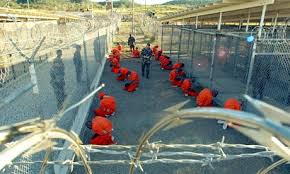
from the Guardian.com
Jess Bravin (from that hotbed of radicalism, The Wall Street Journal) described in his book The Terror Courts: Rough Justice at Guantanamo Bay the failure of the system of military commissions designed by a group of cynical men in the second Bush Administration. The courts collapsed under the weight of the negligence of the people who made it. Dick Cheney, John Yoo and others so totally disdained the concept of the rule of law that they deliberately placed incompetent judges on the courts, says Brevin, so defendants could not get a fair trial. Even when people within the administration protested, these bizarrely un-American men railroaded though a series of deliberately dysfunctional procedures.
Turns out that this kind of thing does not work. Our legal system does work, though imperfectly. We can convict bad guys while also defending their rights. Security and ordered liberty are not incompatible.
Now, I understand the problem with closing Gitmo. The people in there really do want to kill us now, whether they did before or not. Arbitrary, nasty imprisonment over 12 years radicalized them, and now we can not in good conscience free them to wreak havoc on the population.
But why is it better to just off the bad guys instead? I'm not sure I fully believe the claim that Obama is using drone strikes solely because he can't close Guantanamo. Still, the correlation is ugly.

from the Guardian.com
Jess Bravin (from that hotbed of radicalism, The Wall Street Journal) described in his book The Terror Courts: Rough Justice at Guantanamo Bay the failure of the system of military commissions designed by a group of cynical men in the second Bush Administration. The courts collapsed under the weight of the negligence of the people who made it. Dick Cheney, John Yoo and others so totally disdained the concept of the rule of law that they deliberately placed incompetent judges on the courts, says Brevin, so defendants could not get a fair trial. Even when people within the administration protested, these bizarrely un-American men railroaded though a series of deliberately dysfunctional procedures.
Turns out that this kind of thing does not work. Our legal system does work, though imperfectly. We can convict bad guys while also defending their rights. Security and ordered liberty are not incompatible.
Now, I understand the problem with closing Gitmo. The people in there really do want to kill us now, whether they did before or not. Arbitrary, nasty imprisonment over 12 years radicalized them, and now we can not in good conscience free them to wreak havoc on the population.
But why is it better to just off the bad guys instead? I'm not sure I fully believe the claim that Obama is using drone strikes solely because he can't close Guantanamo. Still, the correlation is ugly.
Thursday, April 25, 2013
Trust Our Courts
America's strength lies in our deep-seated belief in the value of the rule of law. At the core of that belief is a faith that questions of guilt or innocence are best resolved in a court of law, run by a judge and adjudicated, in part, by a jury.
Now we have a number of Americans, many of whom consider themselves great patriots, who argue that our system of justice can't handle its fundamental purpose. For example, John McCain and Lindsey Graham say that terrorists and other criminals, like Dzhokar Tsarnaev, should not be tried, but should be held indefinitely as "enemy combatants." "Our goal at this critical juncture," they said in a joint release "should be to gather intelligence and protect our nation from further attacks." Graham later added, “The last thing we may want to do is read Boston suspect Miranda Rights telling him to 'remain silent.'"
These comments reflect a serious -- and tragic -- misunderstanding of the principles of justice underlying our system. This is not "Law and Order," in which some heinous criminal goes free on an arbitrary ruling from a character actor. Federal judges know their business, and federal prosecutors seldom lose cases they pursue. Not only that, but the rights of the accused do not hinder prosecution or impede justice. Quite the opposite is true: by ensuring a fair trial, courts increase the likelihood that convictions will "stick" and that sentences will be fulfilled.
McCain's comments are especially sad. This is a man who, rightfully, has argued for years against the use of torture because it reflects badly on Americans and endangers our soldiers. Why can't he see the implications of his position here/
Now we have a number of Americans, many of whom consider themselves great patriots, who argue that our system of justice can't handle its fundamental purpose. For example, John McCain and Lindsey Graham say that terrorists and other criminals, like Dzhokar Tsarnaev, should not be tried, but should be held indefinitely as "enemy combatants." "Our goal at this critical juncture," they said in a joint release "should be to gather intelligence and protect our nation from further attacks." Graham later added, “The last thing we may want to do is read Boston suspect Miranda Rights telling him to 'remain silent.'"
These comments reflect a serious -- and tragic -- misunderstanding of the principles of justice underlying our system. This is not "Law and Order," in which some heinous criminal goes free on an arbitrary ruling from a character actor. Federal judges know their business, and federal prosecutors seldom lose cases they pursue. Not only that, but the rights of the accused do not hinder prosecution or impede justice. Quite the opposite is true: by ensuring a fair trial, courts increase the likelihood that convictions will "stick" and that sentences will be fulfilled.
McCain's comments are especially sad. This is a man who, rightfully, has argued for years against the use of torture because it reflects badly on Americans and endangers our soldiers. Why can't he see the implications of his position here/
Thursday, March 21, 2013
What Gitmo Means
When President Obama promised five years ago to close the detention center at Guantanamo Bay, he recognized the blight of an American regime of indefinite imprisonment. All of the fundamental principles of American government abhor the imprisonment of people without trial and without the opportunity to confront the charges against them. Even the current Supreme Court, which includes staunch security-state advocates like Samuel Alito and John Roberts, has repudiated the claim that the executive has the power to hold people at its whim.
Today, prisoners at the camp continue a hunger strike in protest of their 11-year detention. That the United States government is a target of such protests is itself shameful. Only people in the weakest of positions, facing the most egregious abuses, resort to such tactics. They should never be necessary against a government committed to individual liberty.
Today, prisoners at the camp continue a hunger strike in protest of their 11-year detention. That the United States government is a target of such protests is itself shameful. Only people in the weakest of positions, facing the most egregious abuses, resort to such tactics. They should never be necessary against a government committed to individual liberty.
Subscribe to:
Posts (Atom)