Showing posts with label UAV. Show all posts
Showing posts with label UAV. Show all posts
Sunday, May 3, 2015
The Best Single Source of Information on Drones
The American Security Project offers a comprehensive description of US security policy as it relates to drone strikes. The advantage to this site, as I see it, is that it does not take an immediate position on whether drones are good or bad for foreign policy.


Thursday, July 3, 2014
On the Assassination of Anwar al-Awlaki
In 2011, President Obama ordered the killing of an American citizen living in Iraq. His name was Anwar al-Awlaki, and he was suspected of orchestrating or inspiring at least three terrorist attacks on American soil. Using an unmanned drone, the CIA vaporized al-Awlaki without submitting his case to a court or convicting him of any crime. In other words, Obama carried out an extra-judicial execution -- the kind of thing generally frowned upon under the rule of law (unless you are John Yoo.)
The problems with this sort of thing are obvious. If the president unilaterally can order the death of a US citizen, there is very little he cannot do. Our system of checks and balances, if it was designed to do anything, was intended to prevent this kind of drastic action being taken without any sort of due process. More specifically, there seem to be direct legal prohibitions on this sort of thing, as legal scholar Kevin Jon Heller pointed out even before the killing.
Recently, the Obama Administration released the memo written to the president explaining why this targeted assassination was legal and justified. Essentially, it invokes the 2002 Authorization for the Use of Military Force (AUMF) and asserts that the government could "reasonably conclude" that al-Awlaki was a member of al Qaeda. The facts behind this conclusion are redacted, with the permission of a federal judge who ordered the release of the memo, so we can't know why they think he was a member of the one specific terrorist organization reached by the AUMF.
In other words, the executive gave itself permission to conduct an assassination based on information known only to the executive.
Where is Ted Cruz when you need him? Why is this OK when Obamacare is a crazy overreach?
The problems with this sort of thing are obvious. If the president unilaterally can order the death of a US citizen, there is very little he cannot do. Our system of checks and balances, if it was designed to do anything, was intended to prevent this kind of drastic action being taken without any sort of due process. More specifically, there seem to be direct legal prohibitions on this sort of thing, as legal scholar Kevin Jon Heller pointed out even before the killing.
Recently, the Obama Administration released the memo written to the president explaining why this targeted assassination was legal and justified. Essentially, it invokes the 2002 Authorization for the Use of Military Force (AUMF) and asserts that the government could "reasonably conclude" that al-Awlaki was a member of al Qaeda. The facts behind this conclusion are redacted, with the permission of a federal judge who ordered the release of the memo, so we can't know why they think he was a member of the one specific terrorist organization reached by the AUMF.
In other words, the executive gave itself permission to conduct an assassination based on information known only to the executive.
Where is Ted Cruz when you need him? Why is this OK when Obamacare is a crazy overreach?
Friday, June 27, 2014
What Does it Mean to be an Ally?
The State if Iraq in Syria (ISIS) is a nasty outfit, and if you don't believe me, ask Bashar al-Assad and Ayman al-Zawahiri. Assad has made himself as infamous as his father by defending his right to gas his own people; Zawahiri is the current head of al-Qaeda, an organization not known for its squeamishness in the face of violence. These men have condemned both the methods and the bloody objectives of ISIS, and, along with the government of Iran, has agreed to share intelligence and personnel in the effort to kick ISIS out of Iraq.
All of these people, as well as the state of Israel and the government of the United States, are banding together to defend the map, as it is constructed below. The status quo, with all of its economic and political implications, reflects a secret process of map drawing conducted by French and English diplomats in the first years of the 20th century. That is still exists is a testament to the extraordinary quantities of blood and treasure governments have been willing to expend in its defense.
What ISIS wants to do is erase all these lines and consolidate the entire region under one, repressive Islamic state based on its blatant misreading of the Koran and in conflict with most modes of fundamental morality. ISIS is mean and ought to be eradicated.
All of these people, as well as the state of Israel and the government of the United States, are banding together to defend the map, as it is constructed below. The status quo, with all of its economic and political implications, reflects a secret process of map drawing conducted by French and English diplomats in the first years of the 20th century. That is still exists is a testament to the extraordinary quantities of blood and treasure governments have been willing to expend in its defense.
 |
| http://www.oilempire.us/new-map.html |
 |
| stratfor.com |
On one level, therefore, it is not at all surprising that so many states would get together to eliminate ISIS. These entities have been at war themselves, however, in nasty ways of their own. For Iran and the US to acknowledge publicly that they are sharing information, therefore, is stunning. It goes to show that we may have more in common that is often recognized.
Sunday, November 3, 2013
Why International Law Matters, Too
Maybe you're a "realist" -- you think pragmatism, not abstract principle ought to dictate our actions, especially in the international theater. Law, you figure, matters less than the application of influence and power in the greater national interest. And maybe you are right, in the end. But if you think that the rule of law is somehow not pragmatic, consider these two stories.
Fueled by information from Edward Snowden, The New York Times and the The Guardian have reported extensively on the widespread, even pervasive, snooping conducted by the NSA.

Edward Snowden
Now, the Agency itself is facing the consequences of its actions. In this piece by Scott Shane, who has been the lead reporter on this story, the spies consider the downside to breaking rules in the pursuit of power. The information gained may or may not be of any real value: do we really need the NSA to give us an economic advantage over Brazil? But, it turns out, our allies do not much like learning that the US government steals everything it can get its hands on. Turns out, theft undermines trust.
Not only that, but it's difficult to rally support allies against rogues like China when the US government itself sees no reason to limit its own behavior.
Likewise, the gunning down of people we do not like, even scumbags like Taliban leaders, can have unintended negative consequences. Sure, Hakimullah Mehsud was a rotten human being. He was brutal and self-centered and mean. He intended to harm American citizens and American interests. He was a liar. But his death at the hands of the US government -- really, at the hands of the President himself -- in a drone strike, may not help much in the long run.

Mehsud, from NYTimes
Just because we can kill people does not mean we ought to do so.
The underlying reasoning behind an adherence to the rule of law is that it provides long-range benefit at short-range cost. When we arrogate to ourselves the privilege of settling scores on our own, we separate ourselves from the larger community. As long as we are the biggest bully on the block, capable of defending ourselves unilaterally, that works for us, if for no one else. But what if we need help? What if we can't go it alone? How do we ask for the aid we need, and if we can we expect to get it?
So be pragmatic, if you like. Just don;t think you can do anything you want and get away with it forever.
Fueled by information from Edward Snowden, The New York Times and the The Guardian have reported extensively on the widespread, even pervasive, snooping conducted by the NSA.
Edward Snowden
Now, the Agency itself is facing the consequences of its actions. In this piece by Scott Shane, who has been the lead reporter on this story, the spies consider the downside to breaking rules in the pursuit of power. The information gained may or may not be of any real value: do we really need the NSA to give us an economic advantage over Brazil? But, it turns out, our allies do not much like learning that the US government steals everything it can get its hands on. Turns out, theft undermines trust.
Not only that, but it's difficult to rally support allies against rogues like China when the US government itself sees no reason to limit its own behavior.
Likewise, the gunning down of people we do not like, even scumbags like Taliban leaders, can have unintended negative consequences. Sure, Hakimullah Mehsud was a rotten human being. He was brutal and self-centered and mean. He intended to harm American citizens and American interests. He was a liar. But his death at the hands of the US government -- really, at the hands of the President himself -- in a drone strike, may not help much in the long run.
Mehsud, from NYTimes
Just because we can kill people does not mean we ought to do so.
The underlying reasoning behind an adherence to the rule of law is that it provides long-range benefit at short-range cost. When we arrogate to ourselves the privilege of settling scores on our own, we separate ourselves from the larger community. As long as we are the biggest bully on the block, capable of defending ourselves unilaterally, that works for us, if for no one else. But what if we need help? What if we can't go it alone? How do we ask for the aid we need, and if we can we expect to get it?
So be pragmatic, if you like. Just don;t think you can do anything you want and get away with it forever.
Thursday, May 2, 2013
How to Avoid Imprisoning People? Kill Them.
The problem with the US prison at Guantanamo Bay is that it has been allowed to lie outside the ordinary system of justice. Prisoners captured by the CIA, by military intelligence, and even by militias just barely allied with the United States have been hauled to Cuba because there is no legally usable evidence against them, and the American government has denied that the Geneva Conventions apply to them.
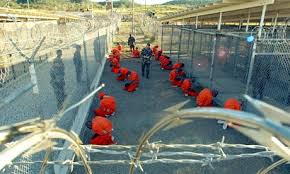
from the Guardian.com
Jess Bravin (from that hotbed of radicalism, The Wall Street Journal) described in his book The Terror Courts: Rough Justice at Guantanamo Bay the failure of the system of military commissions designed by a group of cynical men in the second Bush Administration. The courts collapsed under the weight of the negligence of the people who made it. Dick Cheney, John Yoo and others so totally disdained the concept of the rule of law that they deliberately placed incompetent judges on the courts, says Brevin, so defendants could not get a fair trial. Even when people within the administration protested, these bizarrely un-American men railroaded though a series of deliberately dysfunctional procedures.
Turns out that this kind of thing does not work. Our legal system does work, though imperfectly. We can convict bad guys while also defending their rights. Security and ordered liberty are not incompatible.
Now, I understand the problem with closing Gitmo. The people in there really do want to kill us now, whether they did before or not. Arbitrary, nasty imprisonment over 12 years radicalized them, and now we can not in good conscience free them to wreak havoc on the population.
But why is it better to just off the bad guys instead? I'm not sure I fully believe the claim that Obama is using drone strikes solely because he can't close Guantanamo. Still, the correlation is ugly.

from the Guardian.com
Jess Bravin (from that hotbed of radicalism, The Wall Street Journal) described in his book The Terror Courts: Rough Justice at Guantanamo Bay the failure of the system of military commissions designed by a group of cynical men in the second Bush Administration. The courts collapsed under the weight of the negligence of the people who made it. Dick Cheney, John Yoo and others so totally disdained the concept of the rule of law that they deliberately placed incompetent judges on the courts, says Brevin, so defendants could not get a fair trial. Even when people within the administration protested, these bizarrely un-American men railroaded though a series of deliberately dysfunctional procedures.
Turns out that this kind of thing does not work. Our legal system does work, though imperfectly. We can convict bad guys while also defending their rights. Security and ordered liberty are not incompatible.
Now, I understand the problem with closing Gitmo. The people in there really do want to kill us now, whether they did before or not. Arbitrary, nasty imprisonment over 12 years radicalized them, and now we can not in good conscience free them to wreak havoc on the population.
But why is it better to just off the bad guys instead? I'm not sure I fully believe the claim that Obama is using drone strikes solely because he can't close Guantanamo. Still, the correlation is ugly.
Sunday, January 6, 2013
"An approach that is so bureaucratically, legally and morally sound "
The Brookings Institution recently published some brief comments and illustrations on a Washington Post series on the Obama Administration's drone policy. Whether US law is ready for it or not, the Obama team has established a formal review process for the decision to kill a foreign national.
Brookings published a flow chart for the process, found here:
http://www.brookings.edu/research/interactives/2012/wittes-byman-terrorist-threat-flowchart
On the surface, the thing seems eminently reasonable and legal. The government only kills "operational" targets who can not easily be captured and prosecuted in the United States. The rationale goes like this: if there is a really bad guy out there, we would like to capture him and try him for crimes, but if we can't we just have to kill him, right?
Maybe. But I just don't think it's as easy as all that.
As the Post article put it, "Obama administration officials at times have sought to trigger debate over how long the nation might employ the kill lists, but officials said the discussions became dead ends." In other words, they are no longer doing the deep thinking here about the moral, legal and diplomatic consequences of what they are doing. Officials admit that the targets they hit these days just are not as important or as dangerous as the targets from five years ago, but the bureaucratic momentum driving the existence of a "top 20" list makes it difficult to complete it once and for all. There will always be a "most dangerous" person, even if he's not nearly so dangerous as people we killed or imprisoned already.
Here's a thought-provoking exchange from the Post: "In one instance, Mullen, the former Joint Chiefs chairman, returned from Pakistan and recounted a heated confrontation with his counterpart, Gen. Ashfaq Parvez Kayani. Mullen told White House and counterterrorism officials that the Pakistani military chief had demanded an answer to a seemingly reasonable question: After hundreds of drone strikes, how could the United States possibly still be working its way through a “top 20” list?"
We still have not conducted a clear and open debate about the legality and utility of these assassinations. Too many people don't know about them or can't be bothered to think about them carefully enough. It's not so much that I worry about a slippery slope -- what will we do if we are willing to blow people up -- though that's not as silly as most slippery slope problems are. Rather, I am concerned that we as a people are changing who we are. We are now the ones who target and kill people because we can do it. I don't think that's a good idea.
Brookings published a flow chart for the process, found here:
http://www.brookings.edu/research/interactives/2012/wittes-byman-terrorist-threat-flowchart
On the surface, the thing seems eminently reasonable and legal. The government only kills "operational" targets who can not easily be captured and prosecuted in the United States. The rationale goes like this: if there is a really bad guy out there, we would like to capture him and try him for crimes, but if we can't we just have to kill him, right?
Maybe. But I just don't think it's as easy as all that.
As the Post article put it, "Obama administration officials at times have sought to trigger debate over how long the nation might employ the kill lists, but officials said the discussions became dead ends." In other words, they are no longer doing the deep thinking here about the moral, legal and diplomatic consequences of what they are doing. Officials admit that the targets they hit these days just are not as important or as dangerous as the targets from five years ago, but the bureaucratic momentum driving the existence of a "top 20" list makes it difficult to complete it once and for all. There will always be a "most dangerous" person, even if he's not nearly so dangerous as people we killed or imprisoned already.
Here's a thought-provoking exchange from the Post: "In one instance, Mullen, the former Joint Chiefs chairman, returned from Pakistan and recounted a heated confrontation with his counterpart, Gen. Ashfaq Parvez Kayani. Mullen told White House and counterterrorism officials that the Pakistani military chief had demanded an answer to a seemingly reasonable question: After hundreds of drone strikes, how could the United States possibly still be working its way through a “top 20” list?"
We still have not conducted a clear and open debate about the legality and utility of these assassinations. Too many people don't know about them or can't be bothered to think about them carefully enough. It's not so much that I worry about a slippery slope -- what will we do if we are willing to blow people up -- though that's not as silly as most slippery slope problems are. Rather, I am concerned that we as a people are changing who we are. We are now the ones who target and kill people because we can do it. I don't think that's a good idea.
Monday, December 31, 2012
Do Drones Fit Under Current Law?
Unmanned Aerial Vehicles -- drone aircraft -- grow more sophisticated and cheaper every day. The Obama Administration has amply proved their effectiveness as weapons, and drones continue to kill people in Yemen and Pakistan almost every week. The political and social impact of those strikes is changing the nature of the conflict in Afghanistan, with consequences military officials can not foresee with any accuracy.
As always, such developments have spread beyond their original use. Law enforcement and counterintelligence types now look forward to the day when they can fly drones in US skies to keep an eye on what's happening in this country. This blog has discussed this possibility before, but the Times considered it again this week.
It's not obvious how drone surveillance fits into current American law. The US Supreme Court recently heard arguments about the use of drug-sniffing dogs, and the way it rules there may indicate how the current justices think about the concept of privacy. The drafters of the 4th Amendment did not envision the government looking at our "persons, papers and effects," and it';s not clear how drone surveillance would affect how "secure" we are in those things, anyway. Police drive back and forth along city streets all the time, and that is not considered an invasion of privacy; if they watching from much farther away but with much better cameras, might that not be simply a more effective way of doing the same thing? Still, the idea is creepy.
But the main point is that once again life has outstripped law. Obama wants rules in place, and that's a start, but Congress and the courts need to get to work, too.
As always, such developments have spread beyond their original use. Law enforcement and counterintelligence types now look forward to the day when they can fly drones in US skies to keep an eye on what's happening in this country. This blog has discussed this possibility before, but the Times considered it again this week.
It's not obvious how drone surveillance fits into current American law. The US Supreme Court recently heard arguments about the use of drug-sniffing dogs, and the way it rules there may indicate how the current justices think about the concept of privacy. The drafters of the 4th Amendment did not envision the government looking at our "persons, papers and effects," and it';s not clear how drone surveillance would affect how "secure" we are in those things, anyway. Police drive back and forth along city streets all the time, and that is not considered an invasion of privacy; if they watching from much farther away but with much better cameras, might that not be simply a more effective way of doing the same thing? Still, the idea is creepy.
But the main point is that once again life has outstripped law. Obama wants rules in place, and that's a start, but Congress and the courts need to get to work, too.
Sunday, November 25, 2012
Another Reason Elections Matter
President Obama has not worked very hard to explain his policy on drone assassinations. By neither denying nor confirming the practice, he has maintained the fiction that they are not really happening; the policy has become one of those open secrets that characterize the worst dictatorships.
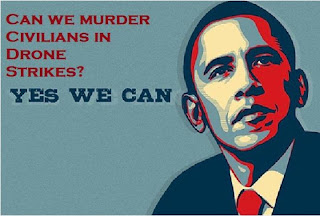
image from "The Excavator"
But, as the New York Times reports today, the specter of someone else killing people arbitrarily apparently made the administration uncomfortable enough to take the whole thing more seriously. Scott Shane writes:
This is why regular changes of power are so important. Obama and his people needed to be a little jittery, and they still ought to be even after the election.

image from "Stirring Trouble Internationally"
image from "The Excavator"
But, as the New York Times reports today, the specter of someone else killing people arbitrarily apparently made the administration uncomfortable enough to take the whole thing more seriously. Scott Shane writes:
The attempt to write a formal rule book for targeted killing began last summer after news reports on the drone program, started under President George W. Bush and expanded by Mr. Obama, revealed some details of the president’s role in the shifting procedures for compiling “kill lists” and approving strikes. Though national security officials insist that the process is meticulous and lawful, the president and top aides believe it should be institutionalized, a course of action that seemed particularly urgent when it appeared that Mitt Romney might win the presidency.In other words, having too much power yourself seems like a good idea; giving that much clout to another seems scary.
This is why regular changes of power are so important. Obama and his people needed to be a little jittery, and they still ought to be even after the election.
image from "Stirring Trouble Internationally"
Monday, July 30, 2012
The Personal Side of Drone Attacks
Elisabeth Bumiller, who covers the Pentagon for the New York Times, offered a different perspective on unmanned aerial vehicle (UAV) attacks in today's paper. Although the killing that these planes conduct is remote in every sense of the word, the impact on the operators is a lot like hand-to-hand combat.
Bumiller describes the job of an operator in Syracuse, New York, whose "day job" consists of following targets in Afghanistan using UAV's. He will monitor the lives of these people for days or even weeks, waiting for an opportunity to kill them when their families are away. As a result, he gets to know the targets far more intimately than any conventional pilot dropping bombs, and maybe more than anyone other than a spy in deep cover. He follows their routines, watches them care for their children, and then blows them up if he can.
Legally and militarily, this part of the story changes nothing, but it does have serious moral and psychological consequences. The issue is not, in this regard, the morality of the killing itself, but of the system that forces the killers to form such attachments to the targets. The pilot in the Bumiller story said that he had no qualms about what he did, but I wonder what the long-term effect is or will be.
Bumiller describes the job of an operator in Syracuse, New York, whose "day job" consists of following targets in Afghanistan using UAV's. He will monitor the lives of these people for days or even weeks, waiting for an opportunity to kill them when their families are away. As a result, he gets to know the targets far more intimately than any conventional pilot dropping bombs, and maybe more than anyone other than a spy in deep cover. He follows their routines, watches them care for their children, and then blows them up if he can.
Legally and militarily, this part of the story changes nothing, but it does have serious moral and psychological consequences. The issue is not, in this regard, the morality of the killing itself, but of the system that forces the killers to form such attachments to the targets. The pilot in the Bumiller story said that he had no qualms about what he did, but I wonder what the long-term effect is or will be.
Saturday, May 12, 2012
Drones Come Home
In April of 2011, I posted a comment here on the implications and consequences of drone warfare. My basic concern was (and is) that targeted killings represent a drift from the rule of law. The United States arrogates to itself the authority to identify wrong-doers and to kill them without any transparent or even vaguely public process. Such actions may seem fine when the targets are foreign evil-doers in the "war on terror," but they still indicate a certain attitude about law and the use of force that troubles me.
In the latest New Yorker, Nick Paumgarten describes the ways in which drone technology is moving into the civilian sphere. "Police tend to have a fetish for military gear," he says, "which the purveyors of [drone aircraft] seem to recognize." Though most drones are too expensive for most law enforcement budgets, cops (and others) relish the prospect of using eyes in the sky to find and capture bad guys just like their buddies in Pakistan do. "Still," Paumgarten notes,
In other words, drones don't have to do bad stuff. Like guns, they are tools to be used by moral creatures, as Paumgarten points out.
But that, precisely, is the problem. If our moral and political framework comes to embrace the unilateral killing of bad guys -- if we are no longer governed by a strict sense of the value of the rule of law -- we are far more likely to behave in ways I don't like. The fact that we have shrugged off drone use overseas indicates that we are inclined to accept it elsewhere. I am not reassured that hovering clouds of bee-like drones are not likely to come into existence for a long time because the technology is too far off.
I'm not worried about the machines. I'm worried about us.
In the latest New Yorker, Nick Paumgarten describes the ways in which drone technology is moving into the civilian sphere. "Police tend to have a fetish for military gear," he says, "which the purveyors of [drone aircraft] seem to recognize." Though most drones are too expensive for most law enforcement budgets, cops (and others) relish the prospect of using eyes in the sky to find and capture bad guys just like their buddies in Pakistan do. "Still," Paumgarten notes,
military innovation usually assimilates itself into civilian life with an emphasis on benign applications. The public proposition, at least at this point, is not that drones will subjugate or assassinate unwitting citizens but that they will conduct search-and rescue operations, fight fires, catch bad guys, inspect pipelines, spray crops, count nesting cranes and measure weather data and algae growth... Of course, they are especially well suited, and heretofore been most frequently deployed, for surveillance.
In other words, drones don't have to do bad stuff. Like guns, they are tools to be used by moral creatures, as Paumgarten points out.
But that, precisely, is the problem. If our moral and political framework comes to embrace the unilateral killing of bad guys -- if we are no longer governed by a strict sense of the value of the rule of law -- we are far more likely to behave in ways I don't like. The fact that we have shrugged off drone use overseas indicates that we are inclined to accept it elsewhere. I am not reassured that hovering clouds of bee-like drones are not likely to come into existence for a long time because the technology is too far off.
I'm not worried about the machines. I'm worried about us.
Friday, April 22, 2011
Drone Strikes and International Law

(picture from http://ssecorp.blogspot.com/2011/08/predator-drone-aircraft-wallpapers_18.html)
As it has done in Pakistan and Afghanistan, the United States has decided to employ unmanned drones to drop bombs in Libya.
The use of drones raises interesting legal, ethical and political questions. Their obvious utility lies in complete absence of risk to American lives with their use. Even if shot down, a drone can only cost us money, not airmen or soldiers. Furthermore, their aim is accurate and precise; they hit what their controllers aim at. From a military persepctive, then, they can be ideal when they can be used.
But all of these strenghts also raise concerns. The Christian Science Montitor quotes David Ignatius in the The Washington Post thus:
My quick reaction, as a journalist who has chronicled the growing use of drones, is that this extension to the Libyan theater is a mistake. It brings a weapon that has become for many Muslims a symbol of the arrogance of US power into a theater next door to the Egyptian and Tunisian revolutions, the most promising events in a generation. It projects American power in the most negative possible way.
I wrote late last year that the problem with the Predators is that they provide too easy an answer to political and military problems.
In other words, it looks and feels like we are playing god, floating around the skies with our ability to kill whomever we like. Send a drone to kill the one we don't like, and everything will OK, right? Well, not always and not for everyone.
Furthermore, drone strikes act more like extrajudicial executions than military maneuvers. In October of 2010, NYU professor and UN special rapporteur on extrajudicial, summary or arbitrary executions John Alston wrote
that We need the United States to be more up front and say, 'OK, we're willing to discuss some aspects of this program,' otherwise you have the really problematic bottom line that the CIA is running a program that is killing significant numbers of people and there is absolutely no accountability in terms of the relevant international laws.
At issue, in part, is that the US targets specific individuals, but keeps the reasons for their killing secret in an effort to protect the program and the hardware. These are not attacks on legitimate military targets as traditionally understood, with the necessary consequence of the death of bunches of people. Rather, the government chooses a person to kill, and then kills him. Because there is never any airing of evidence against this person, never mind a trial, the attacks raise serious concerns about due process.
It's ironic, of course, that international law will not give much resistance to the arbitrary killing of dozens of men, largely through the accidents of fate, that result from traditional bombings, but has no place for the assassination of a single person. Ethically, it seems better in some ways for the US to try to identify people who really "dserve" to die.
Millbrook School student Sarah Whalen wrote a very good essay on these questions in 2006. To quote her:
The United States’ use of targeted killing is an unwise decision in terms of its own foreign and domestic policy. It not only is contradictory to American values, but violates international law and has been frowned upon by the worldwide community. However, thus far this has not stopped its use or changed its legality within American domestic law. Although previously banned, assassination can be ordered by the executive branch from the powers delegated to the President by Congress. Even though permitted under U.S. law, the negative effects hinder the progression in the fight against hatred and violence that the world is currently facing in the twenty- first century.
Subscribe to:
Posts (Atom)