SCOTUSblog » Academic Round-up

Showing posts with label baseball. Show all posts

Sunday, July 13, 2014

On the Purpose of Rules

I am not a huge fan of instant replay in professional sports. There certainly are some instances in which it is helpful and right: the infamous case of Jim Joyce's missed call at first base to break up a perfect game comes to mind, for example.
Joyce was looking right at the play before he called the runner safe, negating the 27th out of a perfect game (nydailynews.com)
Most of the time, though, the calls that people want to check (and by "people," I mostly mean TV and radio commentators) don't really need to be checked.

Here's what I mean by "need." The point of the out/safe rule, for example, is that runners need to get to the base before the defense tags them or the base they are forced to go to.* This is the fundamental principle of the game, and so needs to be enforced as exactly as possible. But he question of ties is really interesting. The rule book says, in the case of a batter-runner going to first base, that the throw must be there before the runner, suggesting that ties go to the runner. In all other force plays, the rule reads that the runner must beat the throw, suggesting the opposite. This ambiguity is germane because it indicates that the rules-makers had a general idea in mind. Not only that, but it is a reflection of the fact that plays as close as a "tie" will be judged more-or-less arbitrarily, and such is life. The game moves on.

The same idea applies to the strike zone. The purpose of the strike zone is to make the game fair and to keep it moving along. Batters can't just stand there forever waiting for the perfect pitch to hit, and pitchers can't throw things just anywhere. This rule was put in place after the first iteration of the game had batters requesting certain locations for pitches, thereby eliminating the pitcher/batter conflict that is so central to the game's excitement.  To some extent, the strike zone is a matter of interpretation by the umpire, even at the major league level. What exactly is the "midpoint" of a batter's body as he is moving and shifting to hit the ball? There are limits beyond which a fair strike zone can't move, but to think that it is precisely measurable within an inch or so is a bit silly.

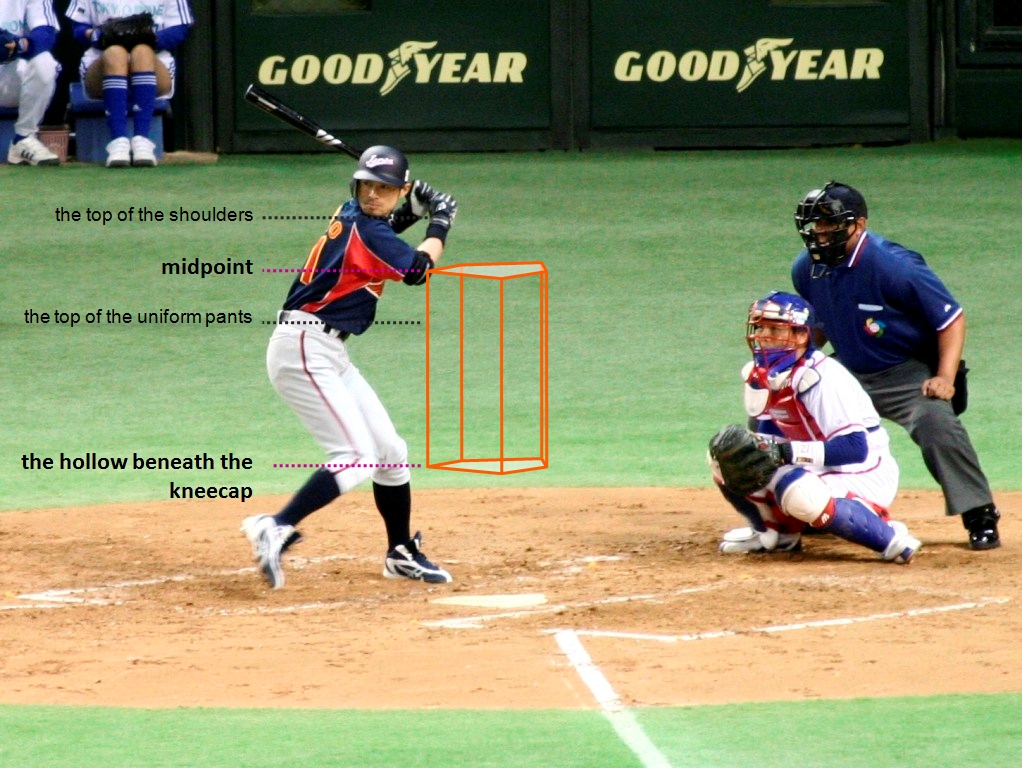
Note that the top of the strike zone is not "at the letters," though the practical effect is almost that high. Note also that the bottom is not "at the knee." (http://en.wikipedia.org/wiki/Strike_zone)

At lower levels of the game, this type of interpretation is even more important. Baseball is not fun to play or watch when no one swings the bat and every at-bat takes five pitches resulting in a walk. For the game to work, people must swing. One job of the umpire, therefore, is balance fairness with the good of the game. Call too big a strike zone and hitters have no real chance; call too few strikes and the game comes to a halt. 

All the griping about umps and strikes, then, needs to be based o these principles, not the fantasy that there should be the perfect zone.

Friday, April 18, 2014

Baseball Umpires, Fairness and Justice

A couple of professors of management (of all things) wrote a piece of the New York Times Sunday Review last week explaining why the Major Leagues need to employ video replay more frequently than they do, and it bugs me. I am not always bothered by stats geeks, even when they talk about baseball -- some of my best friends are like that. But this argument reflects a serious misunderstanding of what an umpire does and why replay is not the answer to their complaints.

First of all, their last line represents a complete loss of perspective, and indicates exactly the problem with their perspective."The question is," they say "whether we, as fans, want our games to be fair and just, or whether we are compelled to watch the game because it mimics the real world, warts and all." Frankly, raising the question of "justice" in the context of baseball is absurd. Baseball is a game, and justice is too big a concept to fit inside a game. It amounts to hyperbole, and makes everything else easier to dismiss.

But every game does need fairness, and anybody has the right to expect that any contest is fundamentally fair. So, do King and Kim give us reason to believe that instant replay would make the game more fair?

They begin with this: "After analyzing more than 700,000 pitches thrown during the 2008 and 2009 seasons, we found that umpires frequently made errors behind the plate — about 14 percent of non-swinging pitches were called erroneously."* 


This claim assumes, of course, that their technology is perfect at judging balls and strikes. I am not convinced that this assumption is valid. Some of the technology I have seen on television appears, in my view, to make patently false representations of the strike zone: where the little white mark shows up in the little box does not correspond to the place the real ball crosses the plate, even on replay. For the sake of argument, though, let's grant them technological perfection.

 They go on:
We also found that the pitch count had an influence over the umpire’s perception of a pitch. When the count was 3-0, and another ball would end the at-bat, the umpires mistakenly called a strike 18.6 percent of the time, compared with a 14.7 percent error rate when the count was 0-0. But when the count was 0-2, with another strike yielding a strikeout, the umpires expanded the strike zone only 7.3 percent of the time, half the error rate for 0-0. The umpires, in other words, appeared biased against ending an at-bat.
This is an interesting thing to consider. Players and coaches have known of this bias for time immemorial. Taking a pitch on 3-0, especially in an obvious way, often will result in a called strike if the pitch is close. This fact is not generally considered unfair, because at any level below the majors, everyone involved does in fact want to avoid "ending an at-bat" in this way too often. Walks have the potential to kill a game, and even the winners of a game riddled with them sometimes regret the experience. 

In other words, the sport benefits when players swing the bat rather than watching pitches go by. You can argue, of course, that in the major leagues this kind of consideration should be taken into account, but the players even at that level understand the way the game operates. This kind of error, therefore, may not be unfair. It is expected as normal business, and does not disadvantage any group in particular, especially in the long run.

Another example from a game I saw last week comes to mind, as well. The runner on first base ran on the pitch, and successfully beat the throw and the tag into second base. His slide, however, brought him over the base, and when the runner stood up he lost contact with the base for a split second. Through the whole move, the shortstop, who had the ball, held his glove on the back of the runner, so when the runner lost contact withe the base he was technically out. The defensive manager called for a replay, and the replay booth confirmed, despite a view from the camera that showed day light between the runner's belly and the bag.

This was the right call. It was fair and -- if we are going to inflate ourselves as King and Kim do -- just. The purpose of the rule is not to catch people in this way. If we allow replay to take over in this way, we will subvert the game rather than supporting it. The same can be say of the famous "neighborhood play" on double plays, which is specifically exempted from replay because the way the game has always been played encourages second basemen turning two to avoid anchoring themselves on the base. We get more double plays -- which are fun -- and fewer injuries -- which are not fun -- as a result.

In other words, the "right" call is not always purely objective. It requires judgment. That's the "human factor" so many people denigrate.


*I would suggest, parenthetically, that if you have analyzed 700,00 baseball pitches, your boss needs to ask more of you.

Thursday, August 22, 2013

Replay continued

The Mets lost a game yesterday in the 10th. With two outs in the inning, a Braves batter hit a ground ball to the infield and was called safe by the 1st base umpire. Replay showed that the batter probably was out "by an eyelash," to use Gary Cohen's phrase. Next guy up hit a three-run home run and one player and the manager were ejected.

For the rest of the game, Cohen and Keith Hernandez referred with increasing frequency the "blown call" that allowed the Braves half to continue. This is perhaps false, and anyway is a waste of time and energy.

First, it is not for sure that the film speed of the cameras used by SNY is fast enough to have gotten the call right. The difference in the play may well have been less than one frame, and if that's true then the camera would be not better than the umpire's eye at getting it right. Second, it was so incredibly close that everyone needs to accept that it could go either way and move on. The game was lost by the first pitch fastball the Braves hit into the stands.

Friday, August 16, 2013

Exactly Wrong

Major League Baseball has heard the noise emanating from all the commentators calling for instant replay. It will expand the use of instant replay in 2014, in an effort to "just get it right."

On the surface, this call to "just get it right" is unobjectionable. Generally speaking, umpires ought to call plays accurately. No intrinsic good comes from missed calls. Also, fields ought to be perfect, weather ought not interfere with play, and schedules ought to be absolutely balanced. These things don't happen, of course, and there is rarely any whining about how grossly unfair it all is. (I say "rarely" because I have heard complaints about all of these things before.) To say that missed calls are lamentable is too obvious.

It's the tone of the complaining I can't take, as if these things were intolerable injustices. Not only that, sometimes I see the same replays the booth guys see, and I can't understand what they are complaining about. Missed calls are not really unjust, most of the time. They are "could have gone either way" kind of deals, and everybody should move on.

But MLB got the fix wrong. By allowing managers to appeal calls, they encourage benches to be planning for umpires to make mistakes, and to schedule their complaints. That's not productive. First, giving everyone three appeals is ridiculous -- I have never seen a game in which there are three calls worthy of appeal. Second, the time wasted in these things will be silly, because the rule has a "use it or lose it" approach that means teams will complain just out of desire not to waste a resource. Third, the dugout is absolutely the worst place to judge just about any call, because you can't see jacksquat from there. Finally, the appeal has to be made to a person sitting in a booth in New York. Why?

What the league should do is hire a fifth ump to sit in the booth and decide when a call is egregious enough to overturn. He would have the experience to judge well, and could check all the ones that need checking without wasting time on silliness.

Sunday, January 13, 2013

Fame and Consequences

I don't generally take halls of fame seriously -- they're just museums. All the hubbub and dispute about who belongs in what hall of fame is the most base mental masturbation.

This week, however, the baseball writers made a statement. They refused to vote anyone into the Baseball Hall of Fame, even though some of the best players in history were candidates. Statistically, Barry Bonds is the best hitter of all time, Roger Clemens is among the best pitchers, and Mike Piazza is the best hitting catcher. None came even close to the 75% of voters they needed to be inducted.

As a museum, the Hall should include all three of these players, and probably also Craig Biggio and Jeff Bagwell (against whom I played in high school). And I have a hard time taking the morality of this kind of thing seriously. After all, Ty Cobb was a racist jerk, and Gaylord Perry only cheated through his whole career.

But I read one comment that rings most true to me: these guys made themselves rich by cheating and got to play the game at the highest level by cheating, but they did not earn honor. They'll have to live with that consequence, if none other.

Monday, August 20, 2012

Bottini Nails the Election

Here's a post from Race Bottini at Off the Bench.

I was doing something else today, but this is much better.

http://offthebenchbaseball.com/2012/08/20/a-baseball-fans-guide-to-the-presidential-election/

The premise: "we’re going to assign each candidate an MLB Manager Equivalent. "

The conclusions: Obama is either Jim Tracy or Kirk Gibson, and Romney is either Bobby Valentine or ... Bobby Valentine.

Tuesday, June 19, 2012

Bobby Valentine is No Genius

Although every commentator at ESPN save Michael Wilbon thinks Red Sox manager Bobby Valentine is "smarter than everybody else in the room," most of what he does suggests the opposite. His own view seems to be that managing a baseball team well is akin to rocket science -- it's a highly technical matter that only people with large brains can do. He imposes wacky and ineffective "innovations" on his players, like making the first baseman dance around behind a runner instead of holding the guy on in the way that thousands of other coaches and players have determined to be best.

I detest Valentine's attitude, not because I think good managers and coaches are not intelligent, but because the best ones understand that it's not technical intelligence that makes them good. Ron Gardenhire is a great coach because almost every year his teams get better over the course of the summer. His success stems not from creating new ways of playing, but from insisting on sound fundamentals and from earning the trust of his players. Valentine alienates the people he works with by trying to prove all the time how smart he is.

Valentine's most recent foolishness came in the form of a call to have machines call all balls and strikes. As part of his rant against human umpires, he cited a "study" showing that the human eye is incapable of tracking a 90 mph fastball all the way to the plate. I don't know whether Valentine has read the paper or not, but I have. It was written in 1984, by Professor A. Terry Bahill of the University of Arizona, and Valentine does not fairly represent its content. Bahill does indicate that professional baseball players can track a ball much more effectively than most people, and that the eye can not literally track the ball all the way to the bat. To quote:

Although the professional athlete was better than the students at tracking the simulated fastball, it is clear from our simulations that batters, even professional batters, cannot keep their eyes on the ball. Our professional athlete was able to track the ball u n t i l it was 5.5 ft in front of the plate. This could hardly be improved on; we hypothesize that the best imaginable athlete could not track the ball closer than 5 ft from the plate, at which point it is moving three times faster than the fastest human could track.

His point is that the advice to "keep your eye on the ball" is not possible to follow.

But here's the part that Valentine did not know or understand:

[this data] makes it d i f f i c u l t to account for the widely reported claim that Ted Williams could sometimes see the ball hit his bat. If Ted Williams were indeed able to do this, it could only be possible if he made an anticipatory saccade that put his eye ahead of the ball and then let the ball catch up to his eye. This was the strategy employed by the subject of Figure 5: this batter observed the ball over the first half of its trajectory, predicted where it would be when it crossed the plate, and then made an anticipatory saccade that put his eye ahead of the ball. Using this strategy, the batter could see the ball hit the bat.
In other words, the batter (or the umpire) does not need to follow the entire trajectory of the ball to know where it will end up. People with natural talent and training can anticipate with very high accuracy where the ball will be at the end of the track. And the umpire has an even greater advantage over the batter, in that he has a second to make a decision after the ball has stopped, whereas the batter does not.

Nobody at ESPN appears to have tried to find the source of Valentine's supposed immense knowledge. Valentine does not claim to have done "the study" himself, so why not ask him about it? Did he actually read it? Does he need help understanding it, despite his enormous intellect? Or is he being disingenuous?

Hm.

Thursday, July 28, 2011

Why it's Ridiculous to Complain About the "Human Factor"

Two nights ago the Pittsburgh Pirates and Atlanta Braves played a 19-inning game with playoff implications. It ended on a play at the plate that commentators immediately screamed was wrong. As has become the routine, people called once again for the use if instant replay to fix the "terrible calls" by umpires.

One of those (literally) yelling yesterday for instant replay was ESPN's Mike Greenberg, who used the typical line about the ridiculousness of preserving the "human element." "In every other area of life we try to mitigate human weakness, but not in major league baseball," he said.

This morning, however, he changed his tune, though without acknowledging it. When it was pointed out that by NFL standards requiring "indisputable visual evidence" to overturn a call this one probably would not have been changed, Greenberg said that in this case the approach should be different. "When the throw beats the runner by five feet like this one did, I think the umpire needs to see indisputable evidence that the defensive player did not tag the runner ... that's just common sense." When Greenberg's partner, Mike Golic, disagreed, and said that the only question should be whether the tag was actually applied ("we see a lot of phantom tags in baseball") Greenberg insisted that the situation should matter.

In other words, it's not only a factual question (whether the catcher tagged the runner or not), but an interpretive one (whether the situation ought to call for a default judgment.) That's something only humans can do.

And despite the vehemence of those on talk radio, I'm still not certain the guy was out.

Tuesday, July 5, 2011

Epistemology, Justice and Baseball Umpires

Major League umpires have endured a lot of flack recently, both from players and from the wonks at ESPN. The complaint is that they miss too many calls, as judged from instant replay. A colleague of mine even suggests that plate umpires ought to be replaced entirely, and that a computer like the one used on TV should call balls and strikes.

In a very limited number of cases I agree with these comments. Mostly, though, I think they are misplaced. Instant replay might serve a useful purpose from time to time, but in most circumstances I think it would make the game worse, not better. Of all proposals, the one to have machines call balls and strikes makes least sense.

First, let's remember why we have umpires. Until very recently, it was not assumed that they could be perfect or near-perfect mirrors of "reality." They were there to manage and faciliate the game, to make it fair. In this view, still appreciated by most players and coaches, a good umpire is consistent and efficient, and thus allows the game to be played at a good pace and on an even "playing field." A good umpire will be impartial, so any "missed" calls will balance out in the long run (and probably in the short run, too.) Bad umpires in this view are inconsistent and/or arbitrary, and make the game more difficult and frustrating to play; no one knows quite to expect and so can't adjust his own actions to any clear standard. This conception of officiating dominates the world of sports; note that when refs missed calls in the World Cup most people reponded with confusion when Americans suggested that instant replay be instituted.

Second, we should consider the relative merits of camera angle and human perception. Before going any further, let me dispose of the idea of balls and strikes being called by a machine. The process of explaining why this is a bad idea, no matter what you think the job of an umpire is, will then help elucidate my ideas on other electronic interventions.

The rule says
The STRIKE ZONE is that area over home plate the upper limit of which is a horizontal line at the midpoint between the top of the shoulders and the top of the uniform pants, and the lower level is a line at the hollow beneath the kneecap. The Strike Zone shall be determined from the batter's stance as the batter is prepared to swing at a pitched ball.

Notice: the top of the strike zone is a "midpoint ... determined ... as the batter is prepared to swing." In other words, it is not an absolute point in the universe that might be measured even with the most precise machinery. The rule (deliberately) includes a "fudge factor," as my high school chemistry teacher used to say. The ump must judge a midpoint, and he must judge when the hitter is prepared to swing. When ESPN or Fox superimpose those electronic boxes over the strike zone, then, some technician is making a judgment as to where those two points are (one in space -- the midpoint-- and one in time -- the moment the batter is prepared.)To pretend that the electronic box is any more "real" than what the ump says, especially when the difference might be a matter on an inch or less, is ridiculous.

Put another way, calling a strike is not a matter of observation in the pure sense, but a matter of interpretation. It requires the application of a rule (an abstraction) to the empirical universe. Only human beings can interpret. We can instruct machines to copy our interpretations, but we can not have the machine do the real work for us. No camera or computer interprets events, the person seeing the picture does. Those cameras only allow people to observe and interpret things in a different way. The "human factor" couldn't be removed even if we wanted to do so.

Plays in the field present a more interesting problem. In some cases, a camera can provide information that umpires ought to use. For example, balls hit just over a homerun line should be homeruns. Umpires can't always see those balls from their positions 200 feet away, and the outcome of the game might be determined quite directly by that one play. Instant replay should be used in such cases. Foul/fair balls, especially in the outfield, might be the same.

Close calls at bases, in my opinion, require the most complicated balancing. Recall that I said the ultimate object is to make the game fair. When an umpire "misses" a call at first base that requires three angles and super-slow-motion photography to see, his call is fair, one way or the other. Frankly, the base might have been positioned 1/4 closer or farther from home plate than the rule says, and that could be the difference. Get over it. The (in)famous Jim Joyce call last year is the counterpoint. He was wicked wrong, and use of replay might have served him well.

"Phantom tags" present the most difficult issue of all, in part because they often incorporate an unofficial, "unwritten" interpretive component. When the ball beats the runner and the fielder gets a tag in the general area of the runner's body, it has long been understood that the guy is out unless he is making a deliberate and extraordinary effort to evade the tag. The rule does not say this, but the fact has generally been accepted as fair. That's the way I see it. You could make a case, however, that this view is essentially arbitrary, that it should not be that way. You might convince me.

So here's my solution. Add a fifth official to every game. He would sit in the booth and watch the game on TV. If he saw a call -- not a ball or strike, but anything else -- that needed to be changed, he would change it. There would be no appeals, no limits on the number of overrides, no timeouts, no bitching. The booth official would be a member of the crew just like the four umps on the field, would have most if not all of the same training, and would not be an outside force intervening to override the umps. He could combine interpretive skill and expereince -- a human perspective -- while using the observational tool of the camera and slow motion.

In this way, we could recognoize the epistemological problem of the "right" call and still achieve justice>